The Cambrian Explosion

In the Cambrian Explosion of 535-million years ago, the genetic information that went into the formulation of the new and varied architectural body-plans of complex creatures appearing suddenly in the fossil record, is a mystery that has baffled science for over two-hundred years.
The fossil record reveals no transitional, trial-and-error, intermediate precursor organisms found in the older Precambrian rock layers below the Cambrian geological strata.
In the Darwinian model, that says nature makes no sudden leaps of progressive development, these missing transitional intermediates should have been found by now and thereby factually demonstrated a continuous, head-to-tail linkage of incrementally developing life-forms leading-up gradually into this Cambrian Period, starting around 535-million years ago.
If they existed, these transitional intermediates would essentially remove the perplexing phenomenon of this being a short-duration event, of being a non-Darwinian sudden explosion onto the scene of previously non-existent organisms, of immerging life-forms exhibiting newly acquired and actualized genetic information at a very specific and definite point in time.
The Cambrian Explosion is an undisputed, universally accepted, scientific fact-based event acknowledged by professional paleontologists, biologists, microbiologists, and biochemists around the world.
The sudden immergence of the Cambrian Explosion sea-creatures into existence, like the fearsome predator the Anomalocaris, is still an unsolved mystery.
The Anomalocaris was a three-foot long predator with sharp teeth that could swim rapidly in pursuit of its prey, like the small crab Marrella.
The Cambrian Explosion introduced for the first-time dynamic motion and visual sensory perception into increasingly more complex ecosystems.
Prior to the Cambrian Explosion, life in the oceans was sessile (non-moving) like the Ediacaran assemblages on the shallow ocean bottoms, or slow-moving like jellyfish, bacteria, and algae that floated around the surface of the oceans.
Bacteria, algae, jellyfish, and the Ediacaran organisms did not possess or need the motion-dependent characteristic of visual sensory perception.
The Cambrian Explosion also arguably needed a full ensemble of new creatures coming into existence simultaneously, to form a broadly varied and viable ecosystem, capable of sustaining survival and reproduction.
This ensemble concept in progressive biological development is totally non-Darwinian.
Anomalocaris could not plausibly come into existence as a one-off entry into an already up-and-running, flourishing ecosystem, because in a fossil record this new and ancient there were no antecedent precursors in existence in the Precambrian Period from which an incremental progression of slight modifications could have gradually brought the Anomalocaris into being.
Try to imagine today introducing lions (plural) as a main predator into the African savanna plains regions, that previously had no lions.
The standard response would be to appeal to the existence of a common ancestral form of large cat from which the lion, cheetah, and leopard evolved gradually in small steps to fit into an equally evolving ecosystem over time.
But the mystery of the Cambrian Explosion is that the Anomalocaris had no antecedent precursor from which to evolve from.
The Anomalocaris had no pre-existing, primary predator to branch off from.
Gradual, small-step, incrementally progressive development in biology did not exist prior to the Cambrian Explosion.
That is the paradoxical mystery to resolve.
Prior to the Cambrian Explosion, there is no complex ecosystem in existence.
Unlike the analogy of lions, cheetahs, and leopards evolving gradually from a common ancestral cat, into an existing African ecosystem that is also evolving gradually, the Cambrian Explosion starts with nothing commonly ancestral.
Anomalocaris therefore needs the full ensemble of secondary predators, and primary and secondary prey, to be all in-place simultaneously as they all come into existence together.
And a previously non-existent ecosystem comes into being simultaneously with the immergence of these new sea-creatures possessing motion and visual sensory perception, in order to provide immediate balance to enable function and fit to actualize.
For a newly invented ecosystem like the Cambrian Explosion to start with balance, it needs all of its living organisms in-place simultaneously.
Again, the paradoxical dilemma with the Cambrian Explosion is that there is no past in the Precambrian ecology that offers a prior, forward-looking glimpse into the organized complexity that is to come in the Cambrian Period.
The full cast of characters apparently is needed on stage at the opening scene of the Cambrian Explosion to start the theater play of life on a new and grander scale.
This nearly instantaneous introduction 535-million years ago of roughly 40 or more, radically different and distinct new living organisms into the ancient oceans, was literally a biological sea-change of seismic proportions.
The sudden introduction of that much genetic biological information fully integrated and coherently functional in a number of complex Cambrian living organisms, would raise the natural question of who were the space-aliens who visited earth and deposited these sea-creatures in the ancient oceans, and then disappeared?
Who were the space-aliens who landed their vessels hovering above the surfaces of the ancient oceans, and then opened their cargo doors to release multitudes of the Cambrian Explosion sea-creatures, immediately introducing the organized complexity of genetic information into the burgeoning new ecosystems of life on planet earth, like instant coffee?
The Cambrian Explosion can accurately be described all in one as being evolutionary, revolutionary, and revelatory.
The near-instant emergence of a massive body of genetic information to create new and distinct architectural body-plans, must have come from a pre-existing database capable of diversification within living cells, or instead was introduced in-whole from a source of origin outside of the known physical universe.
Complex, highly specified, and coherently integrated systems of information do not rapidly originate out of nothing previously non-existent…be it physical matter or a creatively thinking mind.
Genetic information that rapidly appears within a short window of time, generating 40 or more newly innovative architectural body-plans and their accompanying lifestyle-habits, in terms of original physical designs totally isolated from any transitional intermediates in the Precambrian Period, cannot plausibly originate without help from advanced space-aliens or an intelligent designing God.
Throw trillions of years of numerous, successive, slight modifications into a purely naturalistic mechanism to produce the Cambrian Explosion, and we will not get close to writing the unique storylines of each distinct sea-creature assuming their well-defined roles within a complex ecosystem.
We will not get close to producing the tight specifications that form the informational blueprints defining each unique creature, coordinated within an immense hierarchical structure of sequential steps to build a living organism.
If we are a biblical creationist, we can see this new appearance of genetic information and its actualized physical characteristics in life-forms, as a top-down arrangement of information and body-plan architecture, producing fully complete and functional living organisms in a very brief span of geological time “right out of the box,” with no assembly tools required.
Biblical creationists see the infusion of new genetic information at the Cambrian Explosion as an extension of the same brilliantly creative and ordered input of information that brought the universe into being at the Big Bang in a split-second moment of time around 13.8-billion years ago, and that started complex life going on earth about 3.8-billion years ago.
These are two events that required unimaginable quantities and qualities of coordinated information to produce the organized complexity, beauty, and functionality we observe in the natural world today.
A Welcoming Environment Must be In-Place
One thing that must be included in this discussion is the need for a complimentary level of biodiversity to be in-place to support a new system of living organisms coming into existence, which can be termed as prior fitness.[1]
This would include the varied lifestyle-habits of the many predator/prey relationships, along with the supporting functional coherence of the surrounding environmental ecosystems.
This is an integration and coordination of complementary realities that when viewed as a whole, stretches beyond credulity the belief that all of this came into being on its own through materialistic causations, through the self-assembling properties of matter-and-energy alone.
Solve the question of the sudden appearance of new genetic information actualized in the introduction of new architectural body-plans and lifestyle habits springing into life during the Cambrian Explosion, and only a fraction of the total ensemble of other internal and external, interacting realities has been explained.
For example, in the 1930’s wolves were unwisely exterminated from Yellowstone National Park in the state of Wyoming, being the prime predator within the biodiversity of a fine-tuned natural ecosystem.
Without wolves, elk became over-populated, that then over-grazed the vegetation and created serious hillside erosion problems.
But equally problematic, coyotes then became the new highest-ranking predator, preying mostly on small rodents, which is also the prey of hawks and owls.
These majestic birds of prey drastically reduced in numbers until wolves were reintroduced into Yellowstone decades later, reinstating biodiversity and ecological balance back into the park.[2]
In the Cambrian Explosion, we not only need to explain the origin of the genetic information that gave rise to this varied group of suddenly immerging new creatures, but also their coordinated lifestyle environment of biodiversity, and the prior fitness set-up within equally complex ecosystems, all requiring information on a quantifiably unimaginable scale.
Moravec’s Paradox
“Moravec’s Paradox[3] is the observation that it’s easy to train AI to do things that people find hard like math and logic, and hard to train AI to do things that we find quite easy like seeing the world and walking.”[4]
Quoting Hans Moravec from his book Mind Child, “It is comparatively easy to make computers exhibit adult level performance on intelligence tests or playing checkers, and difficult or impossible to give them skills of a one-year-old when it comes to perception and mobility.”[5]
“Artificial intelligence is the ability of a digital computer or computer-controlled robot to perform tasks commonly associated with intelligent beings.”[6]
Moravec’s Paradox makes the insightful observation in this Age of Information, that because modern machines can perform complex calculations like finding the square-root of 3,497 to three decimal places in a spit-second, we naturally make the incorrect assumption that machines can also perform “simple” functions that a one-year-old child can do.
For example, a one-year-old child giggles and laughs when I play “peek-a-boo” by taking my hand away from covering my face and saying “peek-a-boo!” then putting back my hand to cover my smiling face.
A young child instantly recognizes that this is a funny game, producing the instant response of first a smile and then laughter.
But this is many times more complex in the individual instructions that must be broken-down into a hierarchical structure of sequential steps of digital computer code for a machine to duplicate this same child’s game…to even begin to create a physical machine robot to replace me, having a smiling face and cheerful voice that could elicit laughter from a child.
Equally difficult is to write the digital computer code for a machine robot that could recognize my playing “peek-a-boo” with it, and come-up with the correct response of a smile and laughter.
The one-year-old child sitting on the floor building a small tower using square wooden blocks is an activity that seemingly is so simple that a young child can do it.
Yet for a machine, this child’s play is many times more complex, requiring the digital binary-code language of 1’s and 0’s to be programmed into the machine that involve the concepts of the recognition, grasping, positioning, balancing, and not knocking over the other blocks as the tower is built.
How does Moravec’s Paradox relate to the Cambrian Explosion?
One key factor in the research analysis of the Cambrian Explosion is not just understanding and explaining how quickly in time the new living organisms came into being, but equally important how motion and its accompanying sensory recognition abilities must be simultaneously functional for an entirely new ecological system to operate, having predators and prey.
Moravec’s Paradox helps to explain the disparate complexities originating in the Cambrian Explosion, in terms of information technology.
Figure 1 shows in a modern, graphically illustrated format a systematic way to automate a logical statement, a concept first introduced by Aristotle.
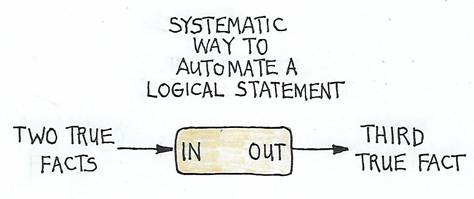
Figure 1
“People had been reasoning logically for millennia, but Aristotle was the first to really analyze the process. He identified a system where if two true facts were stated, a third true fact followed logically.”[7]
An example might be:
First true fact: The sun shines at daytime.
Second true fact: The sun is shining now, therefore:
Third true fact: It is daytime.
Applying this straightforward process to the Cambrian Explosion using Moravec’s Paradox:
First true fact: Machines can easily calculate the square-root of 4,283 to three decimal places, but most humans cannot.
Second true fact: A one-year-old child can easily stack cube-shaped wooden blocks into a tower, but machine robots have considerable difficulty performing this task.
Third true fact: The information processing capacity of machine robots constructed of metal, plastic, and wires is therefore demonstrably different from the organic thinking capacity of human mind/brains consisting of chemically molecular neurons.
A machine robot is processing existing information.
A one-year-old child stacking wood blocks to create a tower is thinking organically in-the-moment.
These two realities are in different categories.
If valid, this argument logically eliminates the random-chance mechanism of blind, mindless, trial-and-error, and undirected processes as an explanation for the immergence of the type and quality of organic free-thinking underlying the genetic information that could build each of the 40-plus new creatures of the Cambrian Explosion.
The blind, mindless, accidental, trial-and-error mechanism of naturalistic materialism, applied to human organic free-thinking, is by definition making a fundamental category error.
The one category, the one quality of information capable of creating the innovative architectural body-plans and lifestyle-habits of the Cambrian sea-creatures, is organic thinking…not mere information processing.
The one category of organic thinking involves creative innovation in-the-moment.
The other category involves the processing of information that already exists.
The adaptive physical variations in Darwin’s finches could either be processing existing innate genetic information that natural selection then adjudicates in the wild.
Or these adaptive, physically variant traits such as larger or smaller beak sizes, could be agency-driven through organic thinking.
Either one is plausible in explaining the adaptive variations in Darwin’s finches.
But the only plausible explanation for the initial coming into existence of a finch-bird as a whole, is organic thinking.
A mere processing unit needs the information to already be in existence ahead of time to be able to perform its function.
Mechanical engineers and AI specialists must input the digital code information into physically constructed machine robots to get them to perform the functions of visual perception and controlled motions, that a one-year-old human child can easily perform.
This analogy between metal and plastic parts in a machine robot compared to biological living cells in a mind/brain, would only become more divided apart if we actually understand the difference between living and non-living informational systems.
One reason why humans have only been successful in building robotic machines made of metal, plastic, circuit boards, and wires, is that building a robot out of chemicals is exponentially more difficult.[8]
Chemicals have side-chains, cross-reactions, and heat requirements to be able to form compounds.
Building a biologically chemical “robot” like a Cambrian Explosion sea-creature, having all of the characteristics of visual perception and mobility to be able to survive and to reproduce as either a predator or a prey, is exceedingly difficult.
The human mind/brain contains about 86-billion neurons and more than 100-trillion connections.
The number of neurons in an artificial network for a robotic system constructed by human engineers, currently might contain around 60 million neurons, for comparison.[9]
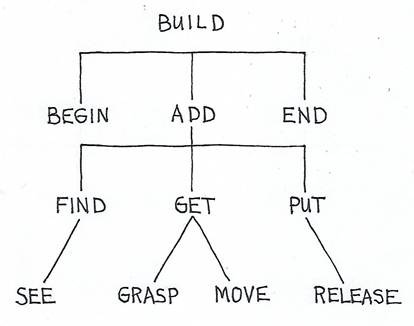
Figure 2
Figure 2 illustrates a hierarchical chart of tasks that might be included in a set of instructions to enable a machine robot to stack cube-shaped wooden blocks into a tower, to match what a one-year-old child can do.
Figure 3 shows the sequence that either a child or a robot might pursue in grabbing blocks from a random grouping on the floor, based upon their starting positions, to build a four-block tower.
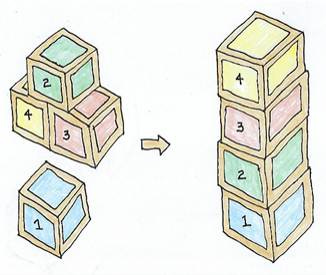
Figure 3
In the field of robotics engineering, it is the human biological mind/brain that designs the neuron networks that constructs the material/electronic device of a machine robot.
So, the question to ask to begin to solve the mystery of the Cambrian Explosion is: How many “neurons” can we imagine it would take above the 86-billion in a human mind/brain, for a Mind/Being God to be able to be the source originator of the new living organisms immerging in the Cambrian Explosion?
The following is a description of the sequential steps of the tasks arranged in the hierarchical chart shown in Figure 2 and pictorially illustrated in Figure 3, needed as a starting guide to programming a robot to stack wooden blocks into a tower:[10]
“So, build is broken down into begin, add, and end, but even add is too big a task and must be broken down.
First, add must find and get a new block and then a hand must put the block on the tower.
All of these commands must be broken down again.
See must recognize what a block is, no matter their size, color, place, or if they are partially obscured.
Move has to guide the hand through complicated parts in space yet never topple the existing tower.
And how should we prevent grasp from grasping a block already in the tower?
How could find determine what blocks are still available for use?
How would builder know if there are enough blocks to build a tall enough tower?
What if the tower starts to sway?
Builder would need to have a basic knowledge of physics to understand why when we look closely, we find a bewildering world of questions that don’t have straightforward answers.
Compare this to the world of chess with its neat rules and clear goals.”
“In building a machine robot, we provide all of the information, and we write the set of instructions.”[11]
“Artificial intelligence is good at chess and other closed-domains having rules, but is not good at open-domains such as law, scientific research, or operating a company.”[12]
We need the well-defined rules (information) upfront in order to be able to then apply artificial intelligence to chess.
The rules and goals must be in prior existence before inputting artificial intelligence into the game of chess.
Chess was already established by humans before the artificial intelligence of machine robots could play chess against humans.
But the force of gravity, the speed of light, and the expansion rate of the universe were not previously established before the Big-Bang creation event occurred.
The architectural body-plans of the Cambrian Explosion sea-creatures were not previously established as designs in existence prior to coming into being.
The lesson of the Cambrian Explosion seen in the light of Moravec’s Paradox is that human mind/brains are using organic thinking to input large amounts of digital information into machine robots to perform specific functions such as mobility and visual sensory recognition, characteristics that are easy for humans but difficult for machines.
Complex Information
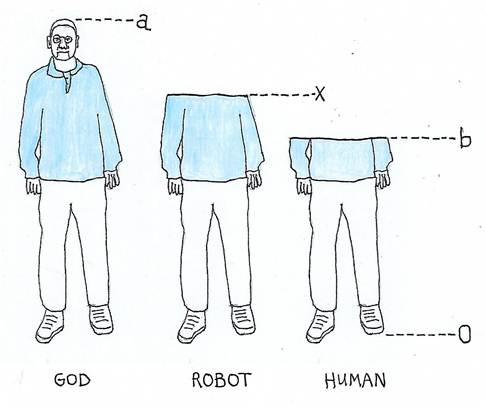
Figure 4
Figure 4 shows three figures representing the different quantities of complex information we might find in God, a future machine super-robot, and in human beings currently.
Complex information might be defined as the arrangement of symbols intelligently designed to convey meaning, such as letters, words, and sentences in a book, newspaper, or magazine…or the digital code of 1’s and 0’s intelligently sequenced to write computer software programs.
Complex, highly specified, and coherently integrated systems of information are the direct opposite of a vast ocean of random gibberish.
In Figure 4, the accumulation of complex information for modern humans from “0” to “b” contains zero random gibberish.
Like for a book, for a movie script, or for an inscription etched in an ancient stone tablet displayed in a museum, random gibberish has no part in the informational databases in the fields of astrophysics, geology, biology, archaeology, paleontology, medicine, economics, history, languages, philosophy, religion, the arts, and all of the other conscious areas of human exploration.
Likewise, the machine robot illustrated in Figure 4 theoretically can have all of the databases of complex information input from the human figure next to it, but only up to the current level of accumulated information at “b.”
The machine robot from “0” to “b” can only mimic or simulate the functions performed by humans supported by the totality of the databases of information for “0” to “b.”
Line “b” is the current theoretical limit of what human engineers and AI specialists can input into a machine robot.
The region from “b” to “x” is a hypothetical leap.
The machine robot from “0” to “b” is constructed out of metal, plastic, circuit boards, and wiring circuits.
The region of the machine robot from “b” to “x” is also constructed of these same material parts.
Human engineers and AI specialists do not know how to impart conscious, organic thinking to material parts, because today we still do not understand what conscious, organic thinking actually is.
We cannot give to a machine robot what we do not currently understand ourselves.
We cannot input organic thinking into machine robots until we actually understand what organic thinking is.
This is why the region in a machine super-robot from “b” to “x” to surpass human thinking capacity through the material components of metal, plastic, and circuitry, producing autonomous free-thinking, is optimistically unscientific speculation.
It is not supported by fact-based science.
Material components cannot think, any more than printed words in the pages of a book can arrange themselves into the complex information of a story.
God does not build living organisms out of metal, plastic, circuit boards, and wiring.
God builds architectural body-plans and their lifestyle-habits out of living biological cells…out of chemistry.
God does not create machine robots in His image.
Humans creating a machine robot having more than 86-billion neurons and 100-trillion connections, and then inputting the mystery recipe for innovative free-thinking that could self-generate more capacity to surpass humans, is inadequate as a reality if the information available coming from human engineers, tops-out at “b.”
It is not the growing database of information accumulated by humans that limits creating a free-thinking machine robot, but rather instead the physical composition of material machines that consists of spinning metal gears and plastic parts.
The region from “b” to “x” cannot acquire free-thinking capacity because the lower portion of the machine robot from “0” to “b” is nothing more than an information processing unit, simulating human functions.
Because God builds living organisms out of biological cells, and humans build machine robots out of metal, plastic, circuit boards, and wiring, there is a non-overlapping region between “b” and “x” in which innovatively creative information through organic thinking cannot be produced.
The material composition of the machine robot from “b” to “x” renders organic thinking categorically unattainable.
God in Figure 4 used creative imagination combined with engineering acumen to create the Cambrian Explosion of new life-forms, an ability that extends from “0” to “a.”
There is a ceiling of informational content that can mimic, that can simulate creative free-thinking up to “b,” above which machine super-robots cannot go.
If 86-billion neurons and 100-trillion connections inside the human mind/brain would in principle be inadequate to design, build, and manage the Cambrian Explosion, then any super-computer created by humans that surpassed this human capacity but fell short of the divine capacity to craft a Cambrian Explosion, would still be the product of intelligent investigator interference…of intelligently directed design.
It would not be the product of coming into being on its own.
A super-computer, machine robot capable of better intellectual and moral reasoning than that possessed by modern humans, would not, under any definition, be the product of random-chance, blind, mindless, trial-and-error, indifferent to outcomes, and undirected processes.
Random-chance is not the process by which humans input functional tasks into machine robots.
The idea that machines will surpass humans, means that machines will have to find and to actualize new information on their own to reach point “x” above point “b.”
Machines can do information searches, process information, and do calculations faster than humans, but this is mere processing and not organic creative thinking.
This means that nothing can create the Cambrian Explosion except a free-thinking mind.
If mutation/selection is a processing mechanism rather than organically inventive thought, then Neo-Darwinian macroevolution will never produce the living organisms of the Cambrian Explosion.
It would appear then that the creative power of the mutation/selection model theoretically superimposed over the long history of progressive development in biology, may be nothing more than a similarly theoretical optimism today projected over machine robots, that in the very-near future machines might surpass the free-thinking capacity of human beings.
The fundamental discontinuity that the information technology subsumed within Moravec’s Paradox now reveals, is that neither non-divine humans nor the machine super-robots that we will ever create in the future are capable of inventing and orchestrating anything as complex or as coherently integrated as the incredible function and fit of the living organisms originating in the Cambrian Explosion.
This is due to the quantity and quality of the complex information that a Common Designer God can generate to create a universe and a life-sustaining planet earth from “0” to “a,” and the lesser quantity and quality of complex information that humans can impart into machine robots, always limited to stopping at “b.”
A Common Designer God and modern humans are organic thinkers, a feature that cannot be transferred to mere information processing units consisting of metal, plastic, and wire circuitry.
The Darwinian materialistic mechanism of random-chance, blind, mindless, accidental, trial-and-error, and undirected processes subsumed within genetic mutation/selection, is by definition the opposite of organic thinking.
Again, Moravec’s Paradox reveals the dichotomy between the organic thinking of a one-year-old child easily constructing a tower on the floor out of wooden blocks, contrasted with the difficulty of a machine robot using the inorganic thinking of a mere information processing unit, to mimic and simulate this same human child’s play.
This poses the fundamental question of the origin of the quantity and quality of the genetic information needed to produce the Cambrian Explosion, in the new light of modern information theory that separates organic thinking from mechanical information processing units.
From my book “Critical Thinking Applied to Science and Christianity.”
[1] Michael Denton: The Miracle of the Cell, published Oct. 28, 2020 by Discovery Science, on You Tube.
[2] Helene Grimaud: Living With Wolves, 2002 podcast on You Tube.
[3] A concept introduced in a 1988 book entitled Mind Child by Hans Moravec, a robotics researcher.
[4] Quoted from Debunking Moravec’s Paradox, on YouTube on Arvind on AI, Jan. 25, 2026.
[5] Ibid, 1:29-1:45 in the video.
[6] A definition of artificial intelligence from Moravec’s Paradox – Why are machines so smart, yet so dumb. On YouTube on Up and Atom, Jul. 8, 2019.
[7] Ibid.
[8] A concept discussed in several of the podcasts on YouTube featuring Dr. James Tour.
[9] Moravec’s Paradox – Why are machines so smart, yet so dumb. On YouTube on Up and Atom, Jul. 8, 2019.
[10] Ibid. At 6:29 in the video.
[11] Moravec’s Paradox – Why are machines so smart, yet so dumb. On YouTube on Up and Atom, Jul. 8, 2019.
[12] Debunking Moravec’s Paradox. On Arvind on AI. Jan. 25, 2026. 9:06-9:25 in the video.